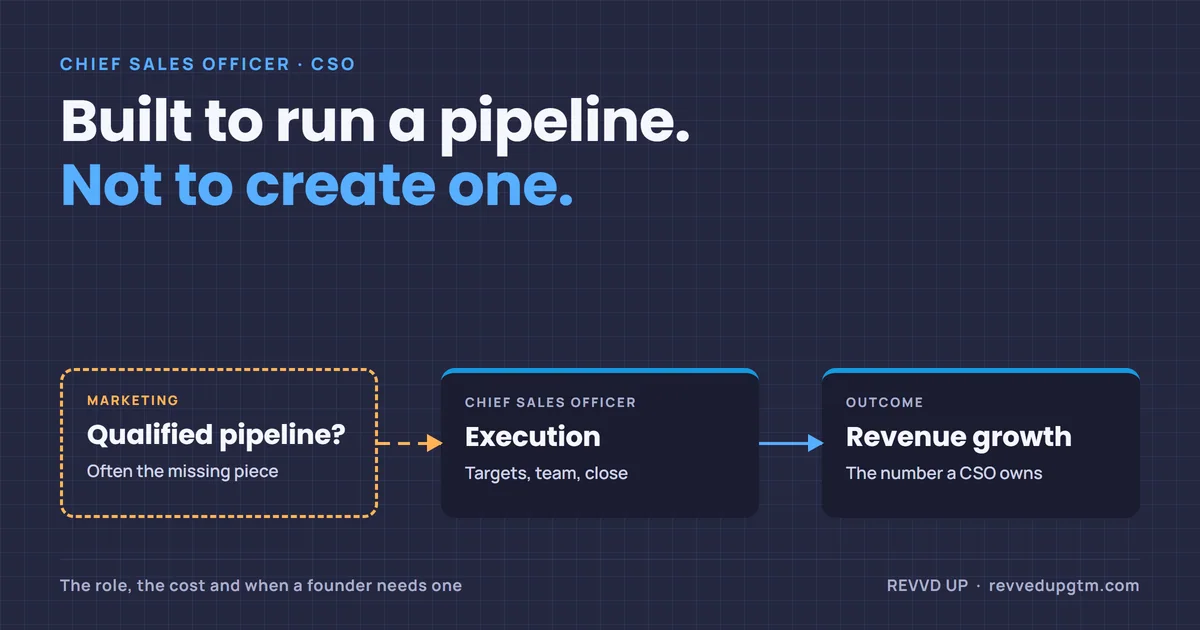
A chief sales officer (CSO) is the senior executive who owns sales execution and answers for revenue growth. The role is built to run a pipeline, not to create one, and that difference decides whether hiring a CSO works. In this guide, CSO means chief sales officer, not chief security officer or chief strategy officer.
What is a chief sales officer (CSO)?
A chief sales officer is the highest-ranking sales executive in a company. Salesforce describes the CSO as the leader responsible for sales strategy and for ensuring revenue growth, and Pipedrive describes the role as focused mainly on execution and closing.
Titles are not standardized. In smaller companies the same person may carry a “chief sales and marketing officer” title and take on marketing too, according to Pipedrive. When you read a job post or a guide, check what the person actually owns before you trust the title.
What does a chief sales officer do?
A CSO sets sales targets, builds and manages the sales organization, forecasts revenue, and decides how salespeople are hired and paid. Salesforce also lists aligning sales with marketing and customer success as part of the job, along with overseeing sales technology.
My view is simple: a CSO is in charge of revenue growth first. Market share and other secondary KPIs come second. That ordering is why the role is so results-driven, and it is why the next point matters. Every item on that list assumes there is demand to work.
CSO vs CCO vs CRO vs VP of Sales: what is the difference?
The roles overlap, and companies use the titles differently. This is how they usually split:
| Role | Primary job | Marketing in scope? | Where it fits at $1M to $10M ARR |
|---|---|---|---|
| Chief sales officer (CSO) | Run sales execution and hit the revenue number | Usually not; works alongside it | Premature unless a pipeline already exists |
| VP of sales | Day-to-day team, quota and process; often reports to the CSO when both exist | No | The usual first sales leader hire |
| Chief revenue officer (CRO) | Revenue across sales, marketing and customer success | Yes | Rare; the scope is larger than the company |
| Chief commercial officer (CCO) | The whole commercial system: message, ICP, sales process, team alignment | Yes | The scope that matches the actual gap, often as a fractional hire |
Salesforce draws the same line between the CSO and the CRO: the CSO oversees the sales department, while a CRO covers a broader set of revenue functions including marketing and customer success. It also notes that companies usually hire a VP of sales first and add a CSO as they scale. For the full CCO side, read our guide to the chief commercial officer.
What happens when a CSO has no pipeline to execute on?
Hand a CSO a healthy pipeline of qualified leads and the job is clear: run the process, coach the team, close. The trouble starts when that pipeline does not exist.
In my experience, marketing does not deliver enough qualified leads most of the time. In every sales leadership role I have held, I ended up figuring out where pipeline would come from myself. The marketing teams I worked beside were usually busy with brand identity, likes and engagement, and were not measured on qualified lead generation. At Dell I saw misaligned sales and marketing produce thousands of worthless leads, which I wrote about in How I Learned to Build Predictable Revenue Growth.
I call this Spray and Pray Marketing in The GTM Engine: traffic and engagement hit record highs, but sales says the leads are garbage. Attention is not revenue. It is also why the same company often has no real ICP. If nobody has defined who the buyer is, marketing cannot target them, and sales cannot screen for them.
Marketing is slowly moving toward revenue, but it has not arrived. The 2026 B2BMX Insights Benchmark Report, published October 29, 2026, found that pipeline influenced is now the top performance metric among B2B marketers at 44%, overtaking opportunities generated and MQLs and SALs. Revenue-based quotas rose from 25.33% in 2025 to 33.33% in 2026, which the publisher ties to holding marketing accountable for pipeline and revenue. Read the other way, about two thirds of respondents are not there yet. I am relying on the publisher’s summary: it does not state the sample size, and more than half of respondents (52.8%) reported revenue under $50 million.
So a new CSO often inherits a marketing function that is not yet on the hook for the number the CSO is judged on. Three things tend to follow:
- The CSO becomes the pipeline builder. Outbound, events, partnerships and content are demand creation and positioning work. That sits closer to a CCO or CRO capability set than to a CSO’s, and Salesforce’s definition of a CRO includes marketing.
- The CSO may not have those skills. Being excellent at closing does not make someone good at building demand. A CSO without a strong CMO is hamstrung and forced to figure it out.
- The CSO falls back on the rolodex hire. Because the role is results-driven, the quickest move is to hire account executives who bring their own industry contacts and let them pull leads and sales from that network. Instead of building a repeatable outbound engine, the company drifts back to the traditional full-cycle AE model. It pays a premium for “industry experience”, and the pipeline lives in the AE’s contacts, not in the company. When that AE leaves for a better comp plan, the relationships can leave too.
The question to ask before you hire is not “do we need a CSO?” It is “who owns pipeline?”
How much does a chief sales officer cost?
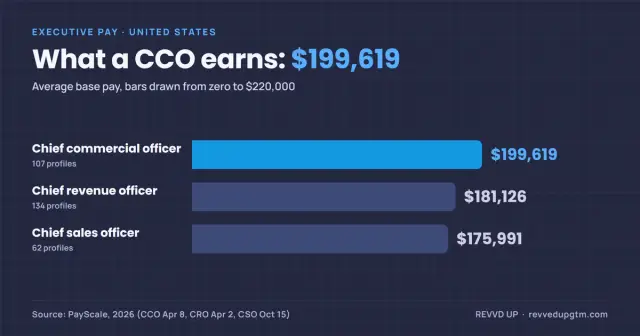
PayScale reports an average US base salary of $175,991 for a chief sales officer, with a 10th to 90th percentile range of $104K to $274K and total pay of $145K to $309K. The page was last updated October 15, 2026 and rests on 62 salary profiles, so treat it as a rough snapshot.
Other sources disagree widely. Salesforce’s CSO page cites about $500,000 a year from Glassdoor, with no date and no definition of what is counted. Gaps like that usually come from what is included (base, bonus, equity) and company size, but neither source explains its number. Use these figures as a planning check, then get current offers from your own market. The total cost of a CSO also includes what you lose while the pipeline is missing.
When does a company need a CSO, and when does it need something else?
Hire a CSO when pipeline exists and the bottleneck is execution. Before you do, answer five questions:
- Where do qualified opportunities come from today, and who owns that number?
- Does marketing report on qualified leads and pipeline, or on traffic and engagement?
- Can you describe your ICP in one sentence that a rep could use to screen a lead?
- Is there a written, repeatable sales process?
- If the new hire had to build pipeline for the first six months, would they have the budget and the skills?
If the honest answer to the first three is “the founder” or “no”, the missing piece sits upstream of sales execution: the ICP, the message, the sales process and the pipeline. That is the front half of the revenue system, and it is what a fractional CCO owns.
At bitcoin++ I rebuilt sponsorship sales around a defined ICP, tiered packages and a multi-stage discovery process. The published case study reports annual revenue up 3x year over year, pipeline up 2.5x, and close ratios above 60%. It is a conference business, not SaaS, which is the point. The system matters more than the title.
Not sure which gap you have? Book a discovery call and we will look at where your pipeline actually comes from.
Frequently asked questions
What does a chief sales officer do?
A chief sales officer leads the sales organization and is accountable for revenue growth. The CSO sets targets, builds and manages the team, forecasts, and works with marketing and customer success on lead quality and conversion. The role assumes a pipeline exists to execute on.
Is a CSO the same as a VP of sales?
No. A VP of sales typically runs the team day to day, and where both roles exist the VP often reports to the CSO. Many companies hire a VP of sales first and add a CSO as they scale, so a startup may never have a CSO at all.
What is the difference between a CSO, a CCO and a CRO?
A CSO owns sales execution. A CRO owns revenue across sales, marketing and customer success. A CCO owns the whole commercial system, including message, ICP and sales process. Companies use the titles differently, so define scope before hiring. The CCO guide compares all three in more detail.
How much does a chief sales officer make?
PayScale reports an average US base salary of $175,991 and a base range of $104K to $274K, based on 62 profiles and updated October 15, 2026. Total pay including bonus runs from $145K to $309K in the same data. Other sources report much higher figures, so check current offers in your market.
Does CSO also mean chief security officer?
Yes. CSO can also stand for chief security officer or chief strategy officer, depending on the company and the industry. In a sales context it means chief sales officer, but confirm the scope in the job description.